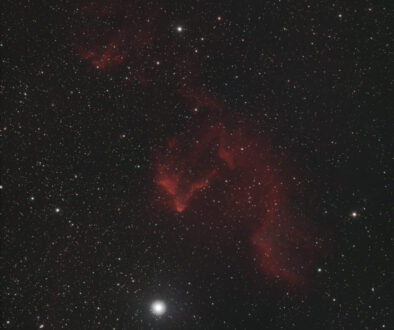
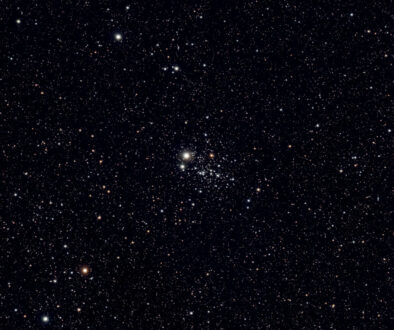
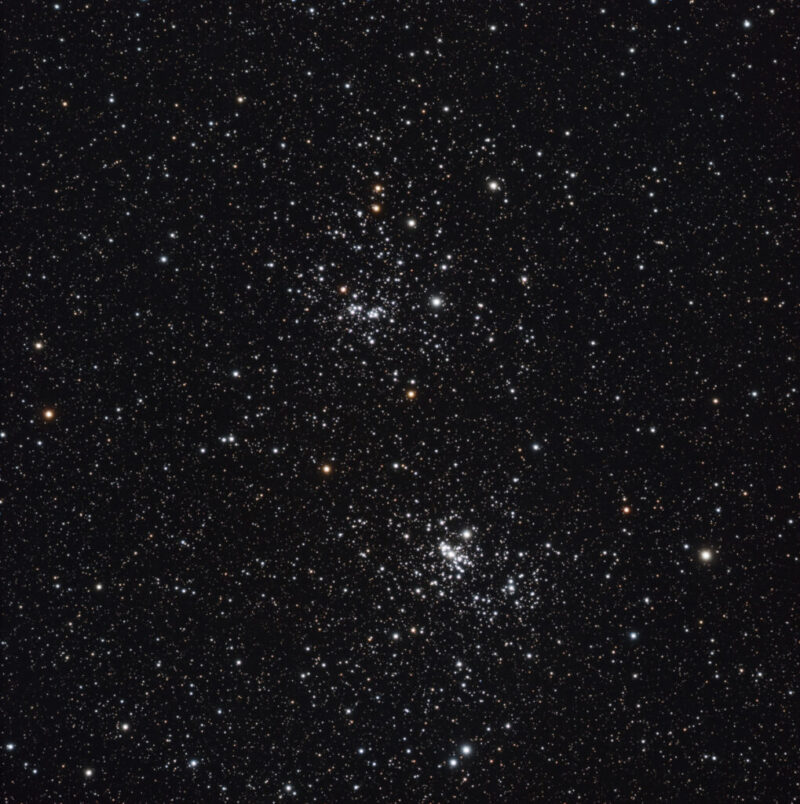
I captured the Perseus Double Cluster in stunning detail
This image of the Double Cluster in Perseus (NGC 869 and NGC 884) was captured under perfectly clear skies, with 4 hours of total integration using the Optolong L-Pro filter.
Acquisition details:
-
Telescope: Explore Scientific ED80CF
-
Camera: ZWO ASI533MC Pro (–10 °C)
-
Filter: Optolong L-Pro
-
Mount: Juwei17
-
Guiding: PHD2
-
Control: NINA on Mele fanless MiniPC
-
Frames: ~4h total integration
-
Processing: PixInsight & GIMP
Polar alignment went incredibly smoothly, thanks to the 3D-printed tripod leg markers I made for my setup. With them, alignment now takes less than five minutes, and guiding stayed perfectly stable all night.
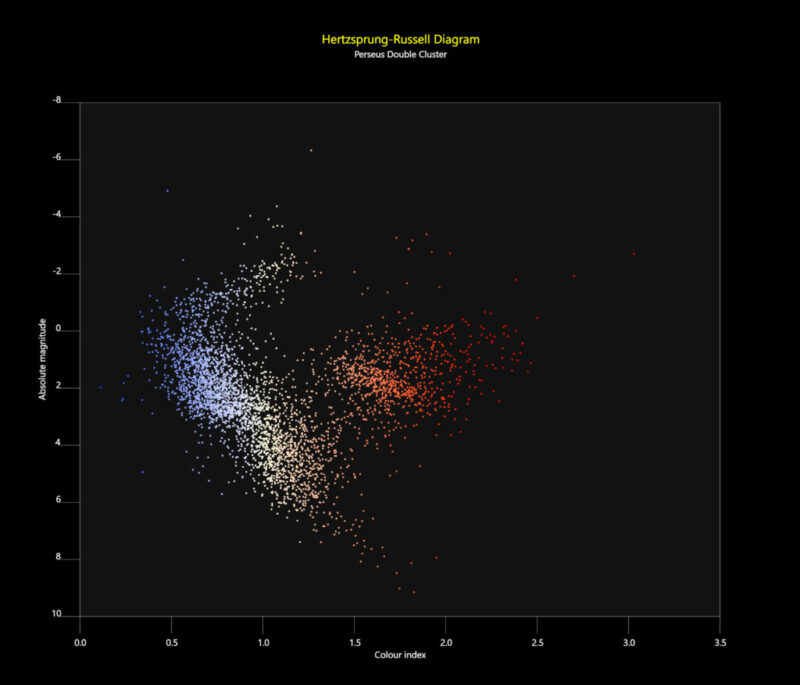
As a bonus, I tried to do some science with the HR Diagram plugin by Cosmic Photons, which generates a true Hertzsprung–Russell diagram from color-calibrated cluster images.
The repository for the PixInsight script can be found here.
Adam Block made a great YouTube video that explains how to use this script.
It’s fascinating to see how well the stars in this field trace the main sequence, just like in a textbook!
The Hertzsprung-Russell diagram of the Double Cluster in Perseus plots absolute magnitude versus color index. Stars occupy a clear main sequence, with the turn-off around 0.5-1.0, indicating the most massive members are leaving the main sequence and becoming blue giants or red supergiants.
The mix of bright blue stars and red supergiants confirms that the clusters are only 10-15 million years old, and the diagram shows how stars of the same age can follow very different paths. (becoming blue giants or red supergiants depending on their mass), making it a natural laboratory for stellar evolution.