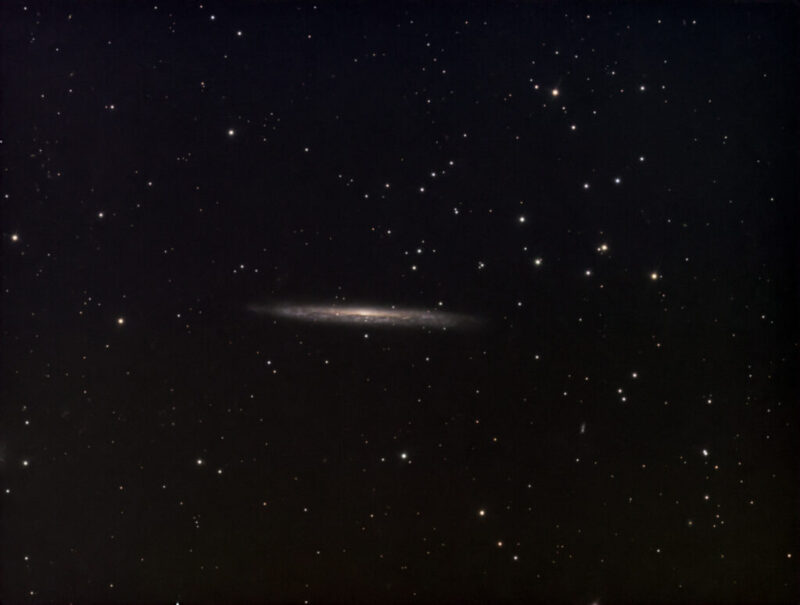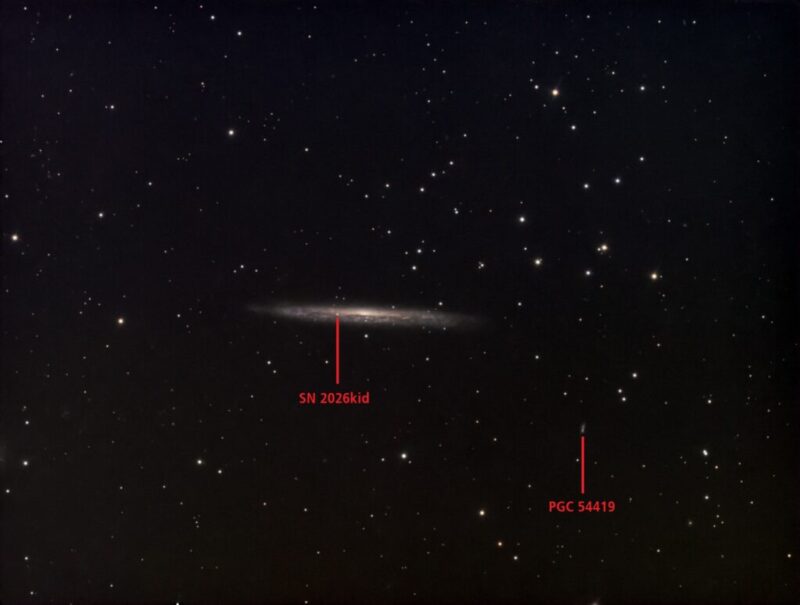
I Captured a Beautiful Galaxy and a Bright Supernova
I captured a beautiful galaxy and a bright supernova


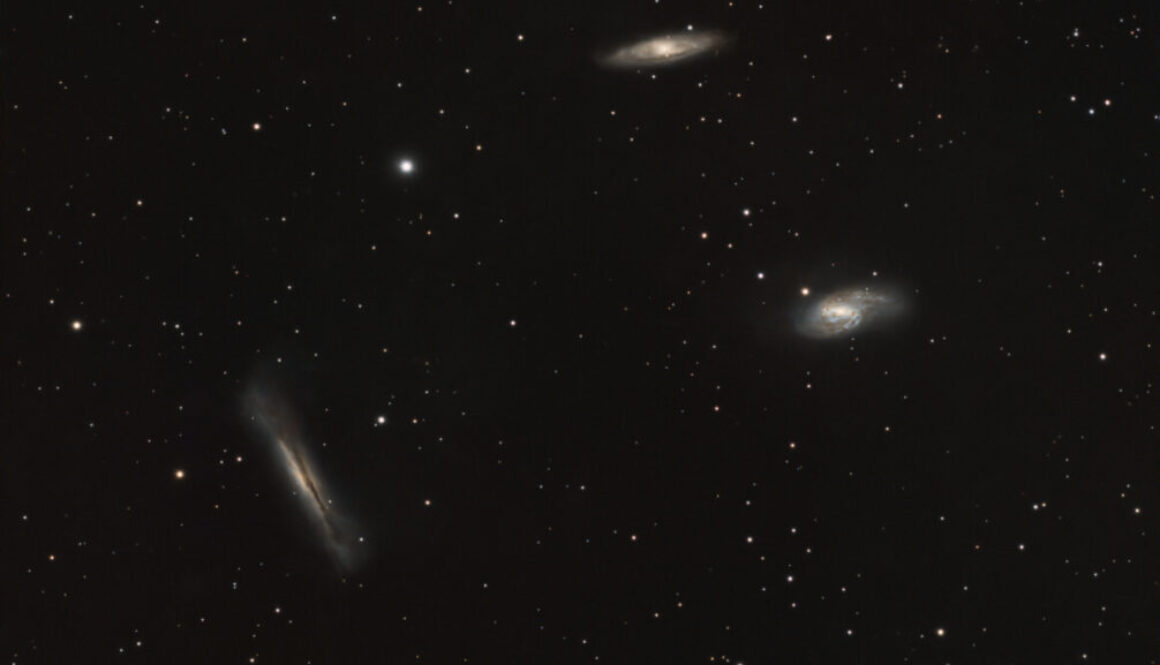
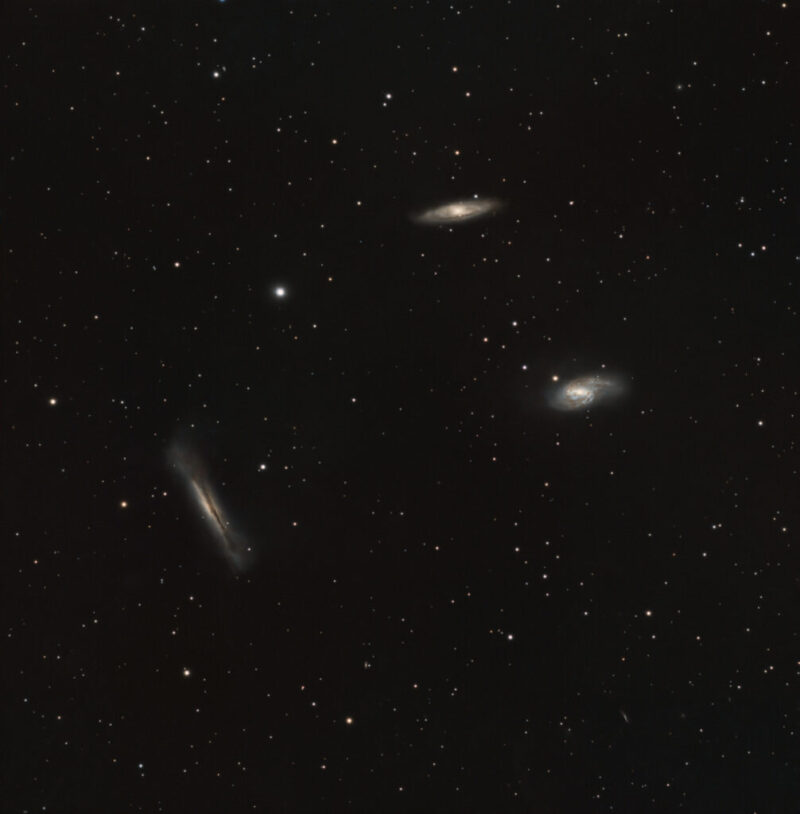
On the evening of April 22, 2026, I captured the Leo Triplet (M65, M66, and NGC 3628) under less than ideal weather conditions. The session was run with my trusted setup, that includes the Explore Scientific ED80 CF APO on an equatorial mount (Juwei 17), the ZWO ASI533MC-PRO with a light pollution filter (the Optolong L-Pro) and N.I.N.A. on a Mele Quieter 4c Mini PC, for full automation of the acquisition. Despite a bright Moon washing out the sky and not-so-good transparency, the data turned out surprisingly nice.
I managed a total integration time of 90 minutes with relatively short subs (45×120 s) to keep the background under control given the bright sky.
The result is not as detailed as I’d hoped, but it’s still quite good for only 90 minutes of integration under a bright Moon. The triplet pops nicely, with the Hamburger Galaxy (NGC 3628) dust lane and the warped arms of M65 and M66 clearly visible.
I especially love the “smiling face” appearance of this trio, with the three galaxies arranged in such a pleasing arc across the frame.
It had been almost five months since my last deep-sky imaging session. Life commitments and work deadlines got in the way, and let’s be honest, the weather in the GTA from November 2025 through March 2026 was brutally uncooperative. Endless clouds, so much snow and rain, and that bone-chilling dampness that made me question why I live here…
My telescope was stored somewhere in my basement, patiently waiting for better times. But yesterday (April 11, 2026) the weather finally cooperated. Clear skies over Richmond Hill, and the temperature not too cold (just +3 degrees). I set up everything out in my backyard well in advance, feeling that familiar mix of excitement and nerves, and carefully planned my imaging targets for the night to get the best from the short imaging time before the clouds were forecasted to roll in.
Windows updates, of course, tried to derail me, popping up just as I powered on the Mini PC. “Not tonight,” I declared, postponing the update while the mount switched back to life.
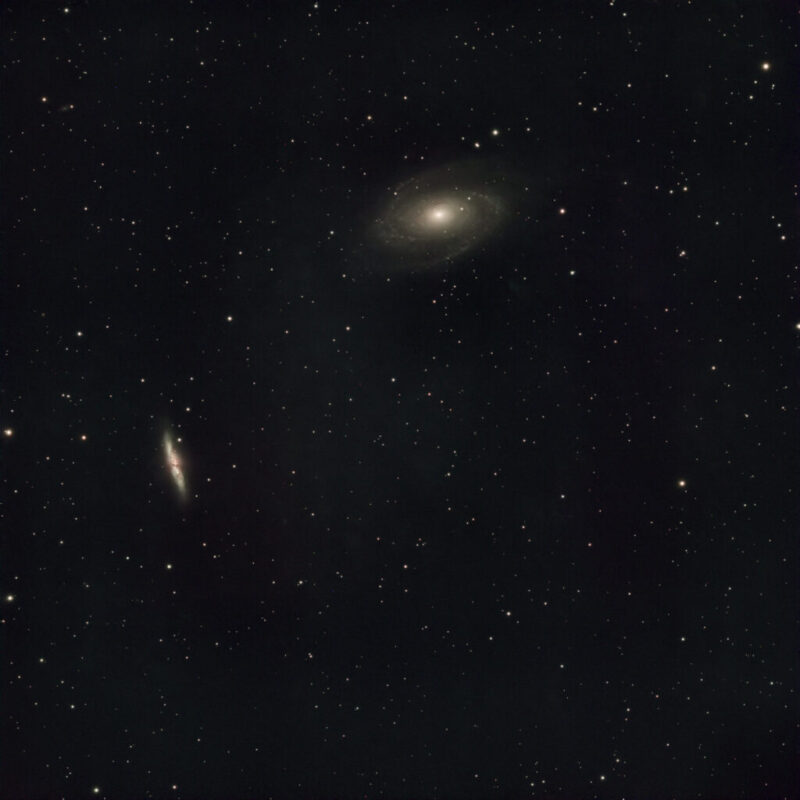
Polar alignment wasn’t the best; it was a bit off, but good enough to start. I didn’t want to waste even 1 minute of my imaging time. I targeted two old favorites that are high in the sky for a number of hours at this time of the year: M81 (Bode’s Galaxy) with its elegant spiral arms, and M82 (the Cigar Galaxy). 50 frames at 120 seconds each, simple stacking and dithering under a sky that felt like a gift after the long drought.
I sat inside monitoring that everything was running smoothly through the night, and I patiently waited for the photons to be collected. I was feeling so good today while post-processing the images through PixInsight. I tried MultiscaleAdaptiveStretch (MAS) to reveal hidden structures inside this galaxy duo: STF for the initial stretch, DBE to remove gradients, SPCC for color calibration, BXT and NXT for sharpening and noise reduction, Curves Transformation, and a final touch with GIMP.
Considering that the total integration time is a little bit less than 2 hours, I’m quite satisfied with the final result. M81’s glow and spirals, M82’s textured chaos.
Astrophotography isn’t always perfect setups or flawless data. Most of the time, it’s troubleshooting a piece of equipment that suddenly behaves in a weird way, waiting for months for the weather to cooperate, fighting Windows updates, overcoming imperfect alignment, and rediscovering the joy in the wait. Looking forward to many more nights like this during galaxy season!
Discover my top 2025 astrophotography hightlights in this 4-minute video. This gallery features globular clusters and open clusters, dozens of galaxies, Saturn with its rings edge-on and a rare Titan’s shadow transit, the Moon, the Sun in H-alpha (with an unexpected visitor – watch until the end to discover), the elusive green flash, colourful nebulae, a bright comet (Lemmon – C/2025 A6), unexpected northern lights, and a few remote telescope images when weather was uncooperative.
May 2026 bring you many nights of clear nights under the stars – looking forward to sharing many more astroimages throughout the year!
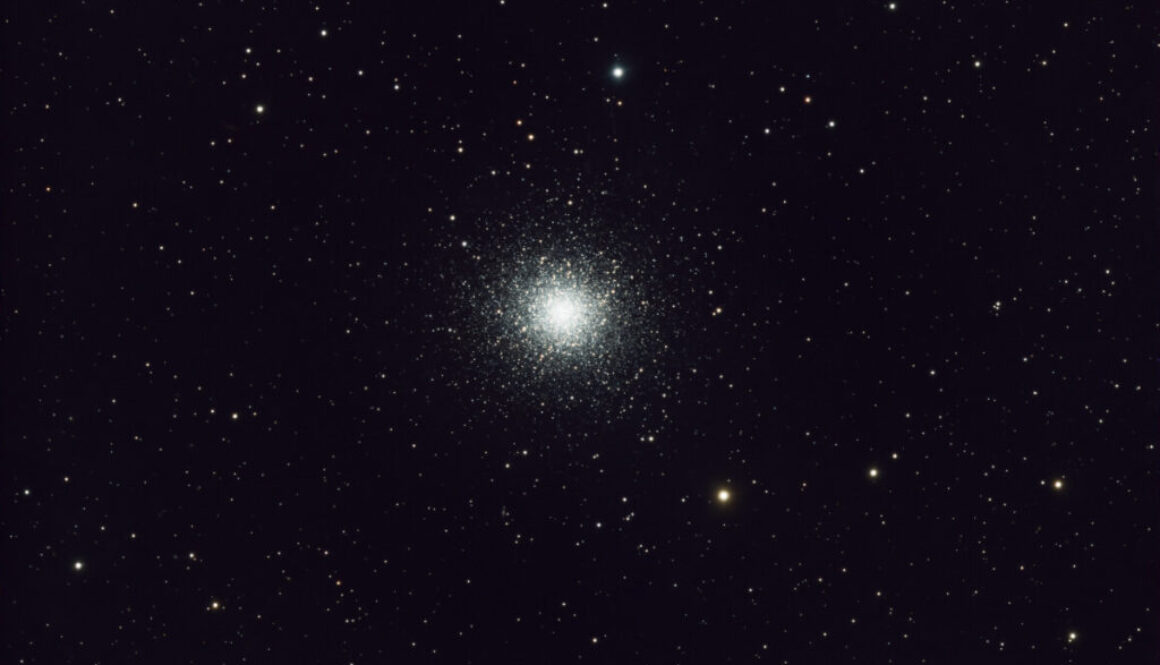
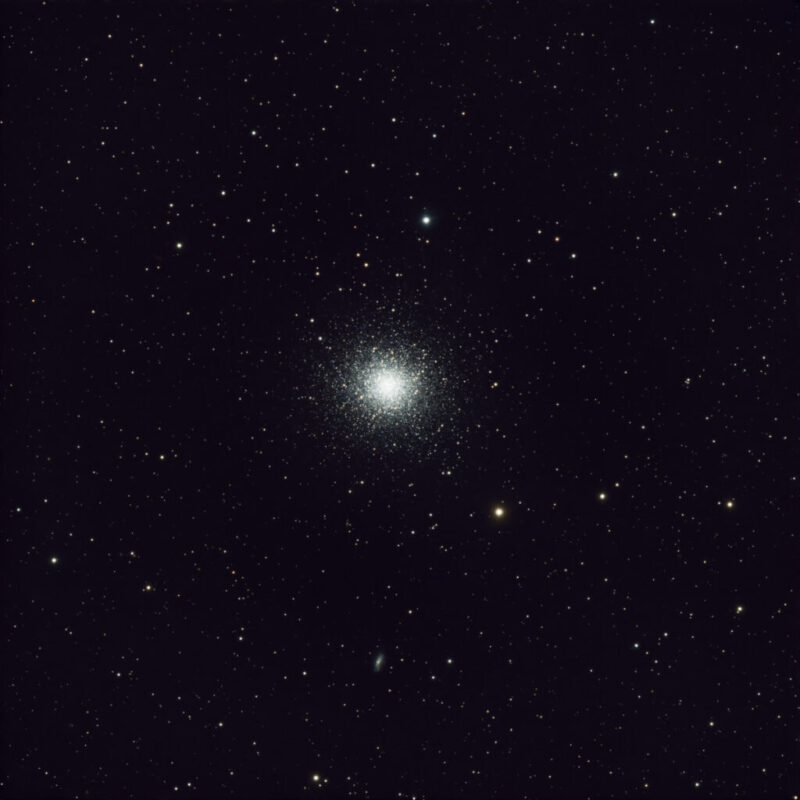
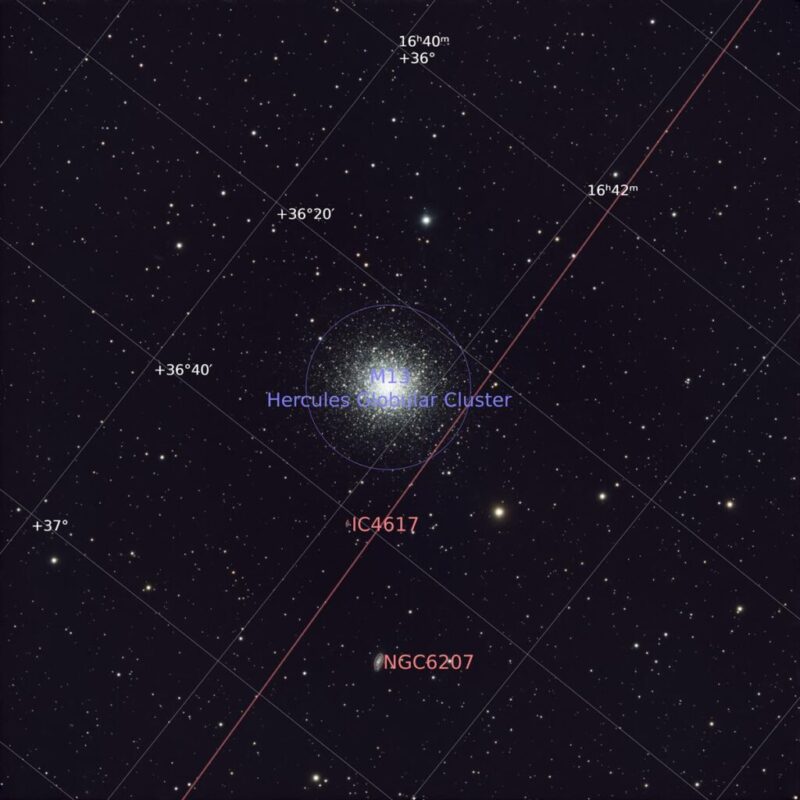
I captured this image of the beautiful globular cluster M13 from my backyard through my ES ED80CF telescope with just 1 hour of total integration time. In the annotated image I highlighted two faint galaxies, NGC 6207 (30 million light-years away) and IC 4617, which is about 553 million light-years away!
M13, located about 25,000 light-years from us in the constellation Hercules, is a dense sphere of hundreds of thousands of ancient stars, making it one of the brightest and most spectacular globular clusters visible from the Northern Hemisphere.
In 1974, the Arecibo Observatory famously sent a radio message toward M13, encoding information about humanity in hopes of reaching distant intelligences – though the message will take about 25,000 years to arrive, by which time M13 will have shifted in the sky.
Imagine, among the myriad stars of M13, a hypothetical planet tidally locked to its sun, where one side always faces the star. On this world, it is perpetually daytime – with a crowded sky of the cluster’s core, where stars are packed up to a hundred times more densely than in our own stellar neighborhood!

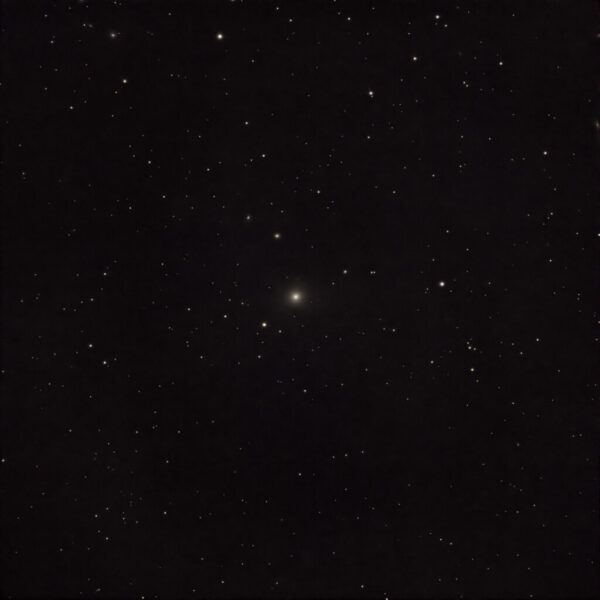
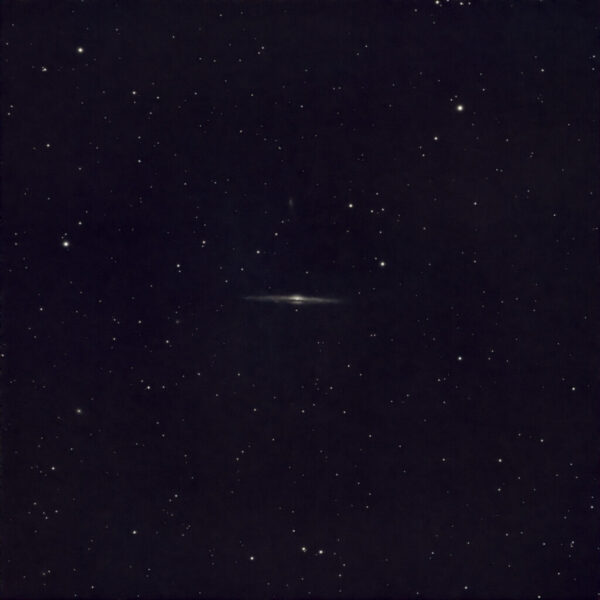
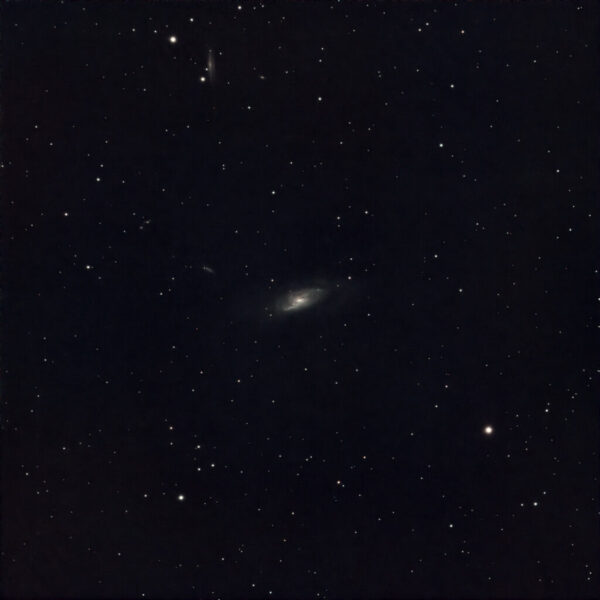
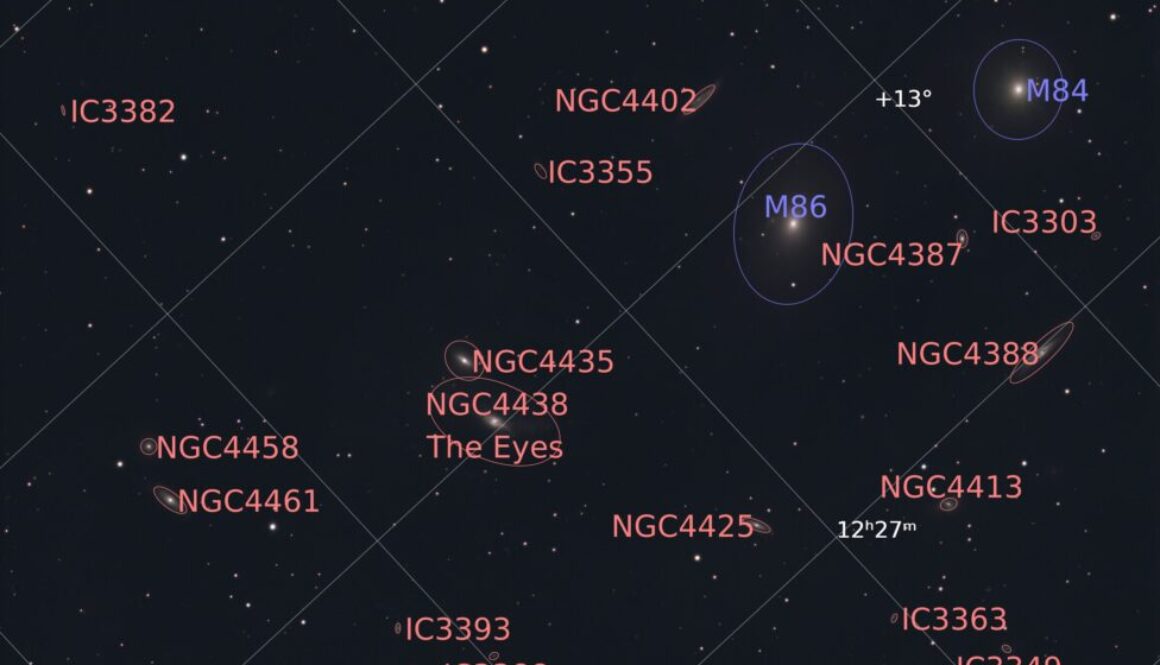
The night of April 17, 2025 wasn’t my typical imaging session, but a sort of a cosmic experiment. Instead of focusing on one deep-sky object, I set myself a challenge: capture as many galaxies as possible in just two hours, all within the rich region of sky stretching from the Virgo Galaxy Cluster to Coma Berenices.
Each galaxy image you will see below was captured with a modest 15 minutes of total integration time. My goal wasn’t to go deep, but to see just how many distant galaxies (and stars) I could fit into a single evening’s work. All the images have been captured with my ED80 APO refractor, a OSC camera (ZWO ASI533MC PRO), a light pollution filter (Optolong L-Pro) and the ASIAIR.
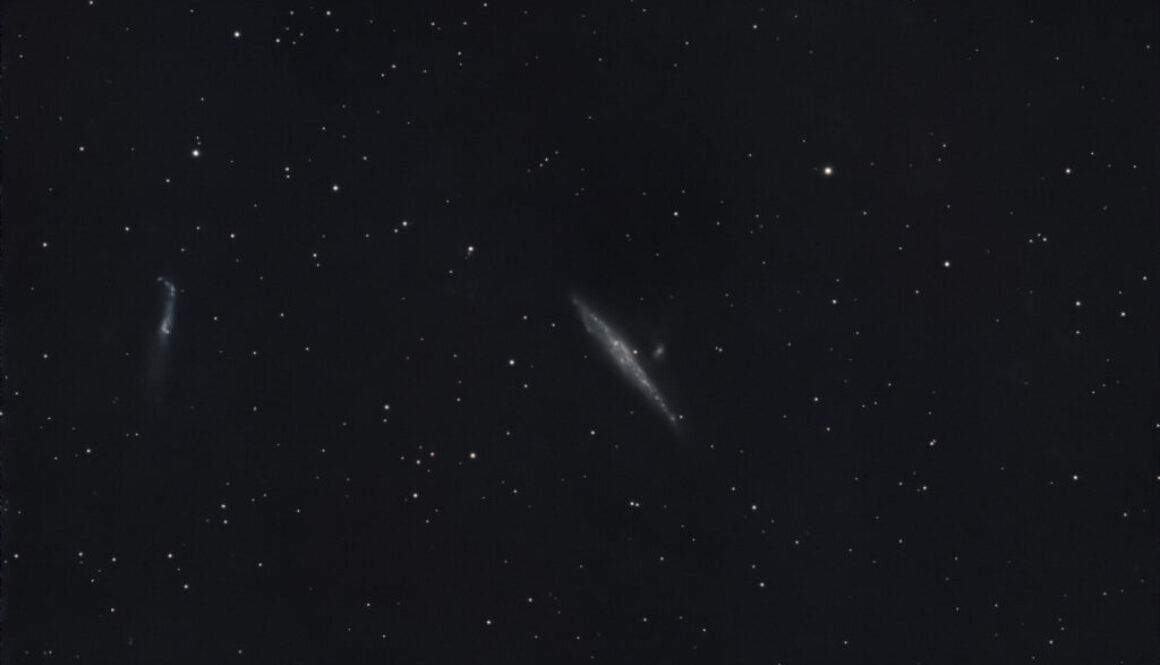
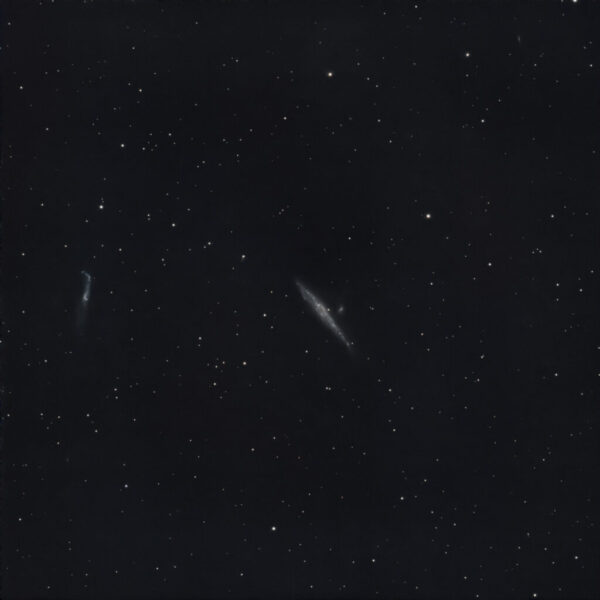
The results? In just this small patch of sky, I managed to photograph M87, M106, Markarian’s Chain, the Needle Galaxy, the Whale Galaxy and the Hockey Stick Galaxy. When you add up the estimated number of stars in these galaxies, you get a total of about 2.65 trillion stars!
I did a little research to roughly estimate of the combined total count of stars contained in all those galaxies, just for fun.
By using the best available figures based on current astronomical data (see table below), the result is beyond human comprehension: 2.95 trillion stars (≈2,950,000,000,000)!
| Galaxy/Group | Approximate Star Count |
|---|---|
| M87 | 1.5 trillion |
| M106 | 400 billion |
| Markarian’s Chain | 700 billion |
| NGC 4565 | 240 billion |
| Whale Galaxy | 100 billion |
| Hockey Stick Galaxy | 10 billion |
| Total | 2.95 trillion |
And below, you can finally see the images of all the galaxies I imaged on that night!
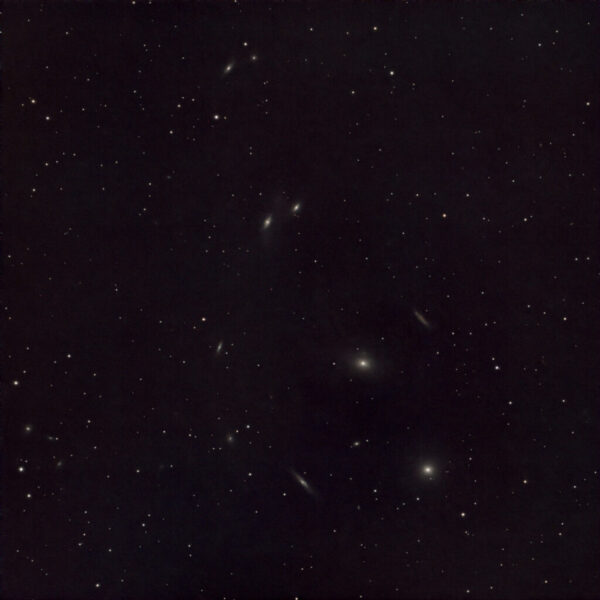
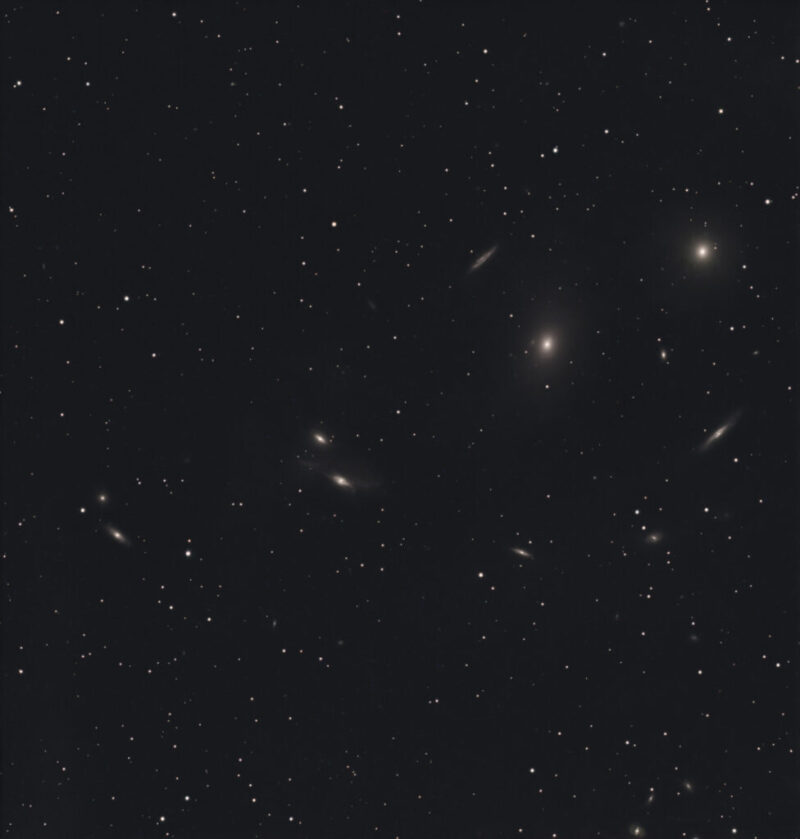
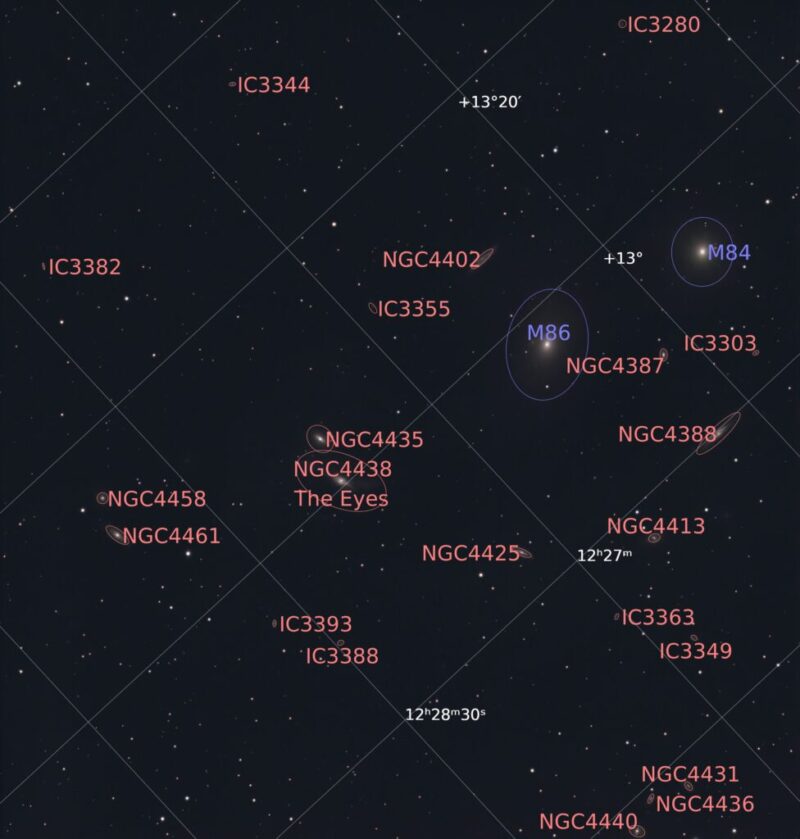
Just checked off a long-time bucket list project: imaging Markarian’s Chain – an iconic string of galaxies in the Virgo Cluster – right from my backyard!
I fully automated the session using NINA’s advanced sequencer: cooled the camera, calibrated guiding, set up a meridian flip, autofocus triggered by HDR changes, dithered every 5 frames, and got real-time progress updates via Groundstation and LightBucket NINA plugins – all running on a mini PC I controlled from indoors.
The setup I used for this imaging session includes my new Juwei 17 harmonic mount, a carbon fiber tripod, the imaging train and a mini PC.

I acquired the images with a Mele Quieter 4C mini PC, processed the images with PixInsight, BlurXTerminator, NoiseXTerminator, and GIMP. Calibration frames included 20 darks, 10 flats, and 100 bias.
After 90 minutes of total integration, I am so thrilled to share the final result: I captured this breathtaking view where you can count 23 galaxies!
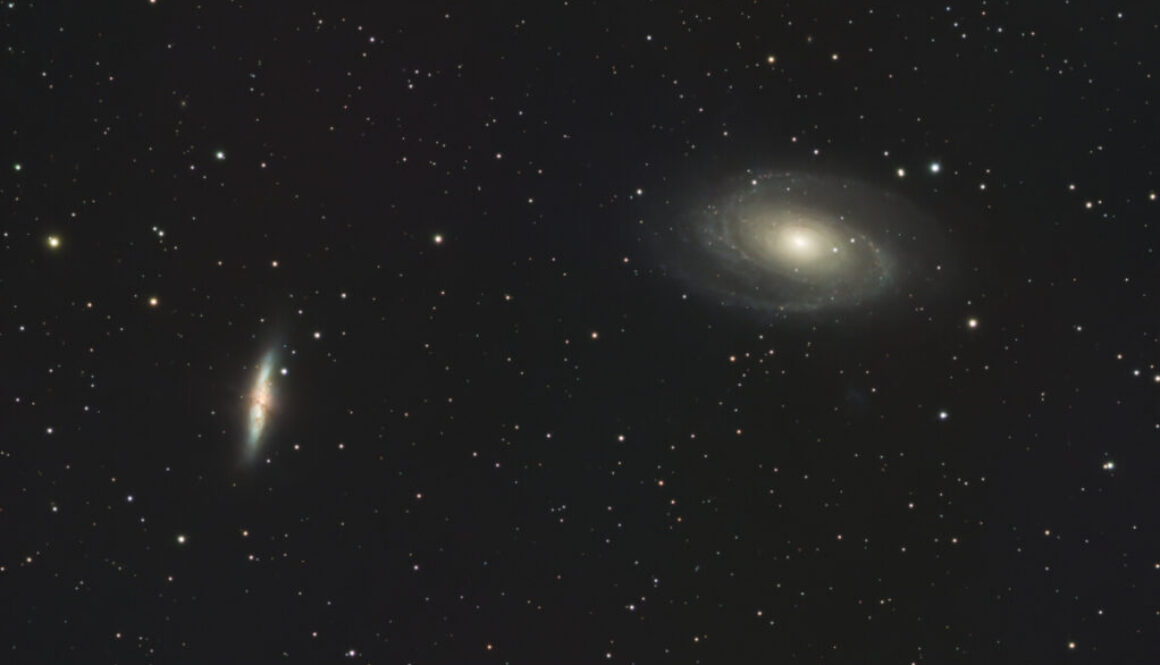
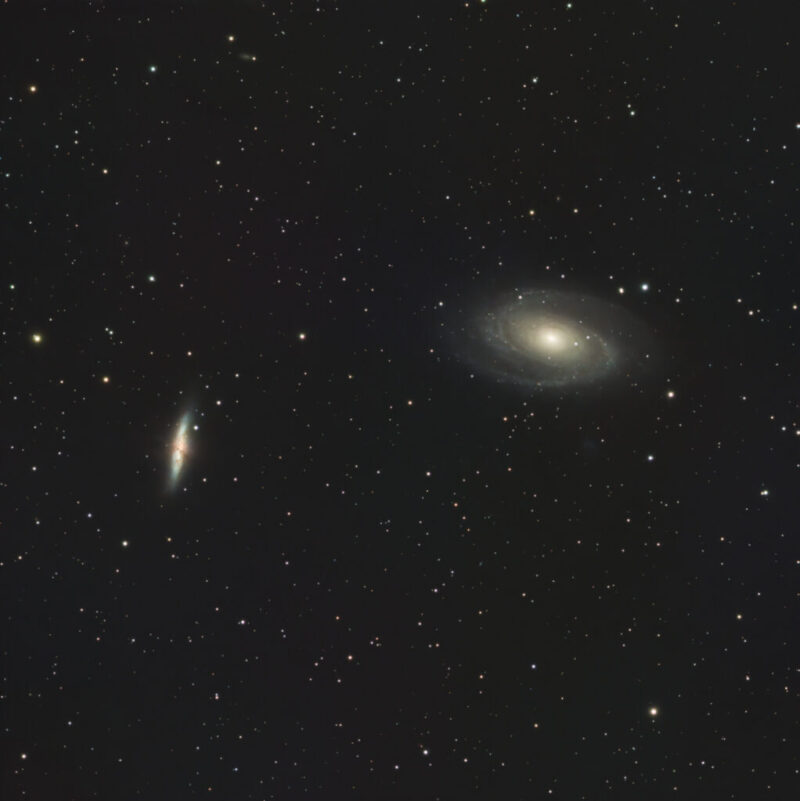
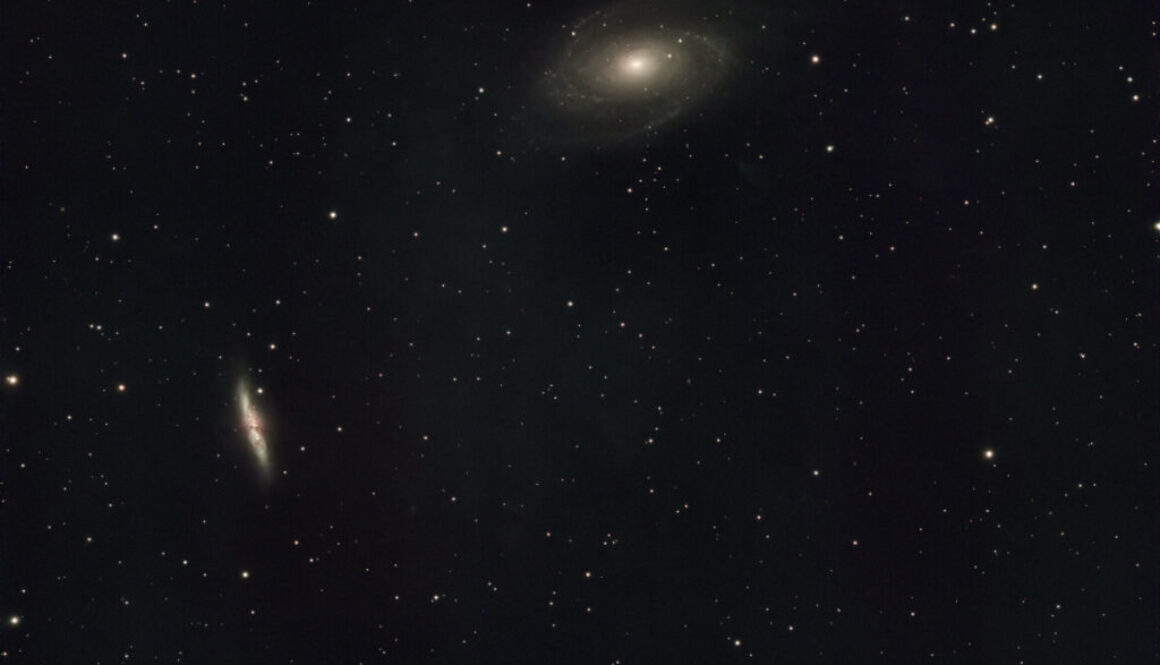
This image features M81 (Bode’s Galaxy) and M82 (the Cigar Galaxy), a galactic duo located in the constellation Ursa Major. M81 is a grand design spiral galaxy situated approximately 11.8 million light-years away, while M82, a starburst galaxy undergoing intense star formation, lies slightly closer at about 11.4 million light-years, according to GAIA data. These two galaxies are gravitationally interacting and are a favorite target for astrophotographers during spring nights in the Northern Hemisphere.
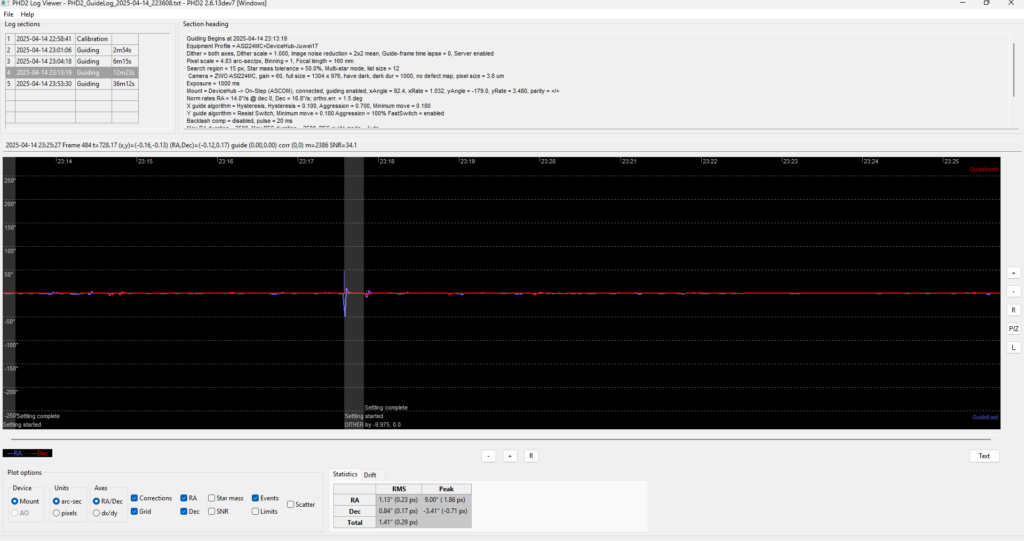
The image was taken with my Explore Scientific ED80 CF apochromatic refractor and a ZWO ASI533MC PRO camera cooled to -10 °C, mounted on the Juwei17. Despite some initial hiccups with NINA settings that limited total integration to just 40 minutes (8×180s + 8×120s), guiding held steady below 0.6″ throughout the session, thanks to PHD2 and a ZWO ASI224MC guiding camera on an Orion Deluxe Mini 50mm Guide Scope.
I couldn’t believe my eyes when I saw the guiding graph – it was one of the smoothest I’ve ever had!
I acquired the images with a Mele Quieter 4C mini PC, the latest addition to my astro-imaging arsenal.
As usual, I processed the images with PixInsight, BlurXTerminator, NoiseXTerminator, and GIMP. Calibration frames included 20 darks, 10 flats, and 100 bias.
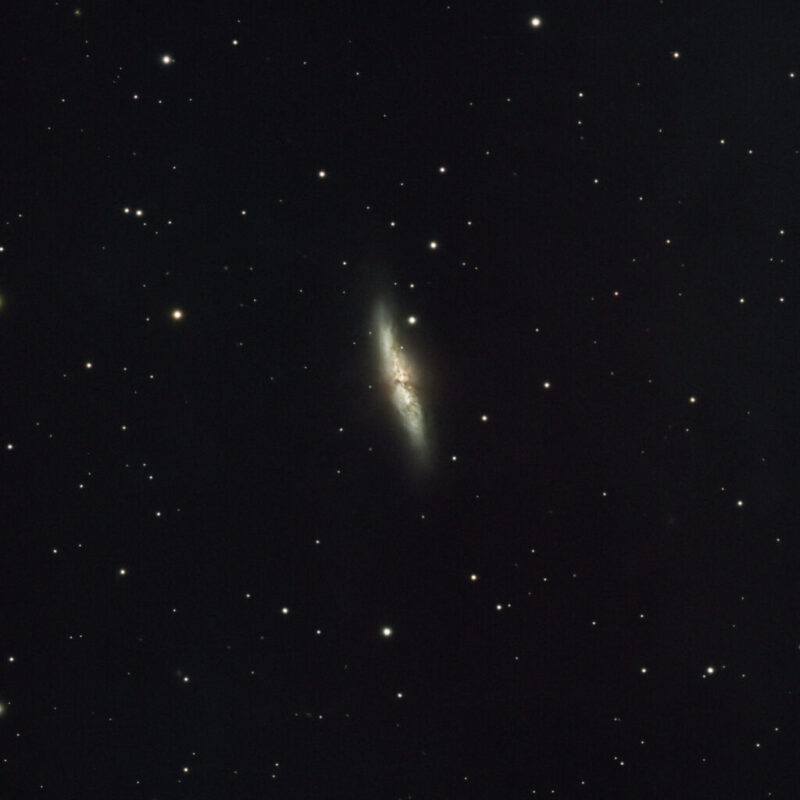
Despite the short integration time, the image reveals impressive contrast and structure -highlighting the elegant spiral arms of M81 and the chaotic, energetic core of M82. I especially love how the faint jets of material bursting from M82’s core are visible – evidence of the intense starburst activity taking place there.
In this image a closer view of the Cigar Galaxy (M82), in Ursa Major.
2024 was an exciting yet challenging year for my astronomical journey. Despite significant obstacles like persistent bad weather and clouds, pervasive fire smoke, poor atmospheric transparency, and the demands of a busy life, I managed to capture some remarkable celestial moments. Below are some of the highlights:
I pulled the trigger and delved into solar observation with a hydrogen alpha telescope. This allowed me to witness dynamic solar features at its maximum such as prominences, filaments, and solar flares in stunning detail.
My lunar and planetary imaging efforts were mixed. While I successfully captured images of the Moon, the year wasn’t particularly favorable for planetary imaging. Nevertheless, I managed to spend some time imaging both gas giants (Jupiter and Saturn) and ice giants (Uranus and Neptune), adding once again these distant worlds to my collection.
A highlight of my year was experiencing the darkness of a total solar eclipse, even though clouds prevented me from directly observing the event itself. I also successfully observed and captured a partial lunar eclipse.
My deep sky imaging journey in 2024 was more rewarding. I explored multiple fascinating targets, including:
This year I finally attended Starfest for the very first time. This renowned star party provided me with opportunities to learn from experts, share experiences with fellow enthusiasts, and observe under dark skies.
I also continued my tradition of visiting the Royal Astronomical Society of Canada’s E.C. Carr Astronomical Observatory (CAO) multiple times this year, enjoying its dark skies nestled between the Blue Mountains and Beaver Valley.
2024 concluded with two spectacular cosmic events: a dazzling comet in the night sky and a major solar storm that ignited an unforgettable Northern Lights display, transforming my astronomical year into a breathtaking celestial finale.
Get ready for another orbit around the Sun and, as always, remember to keep looking up at the stars!
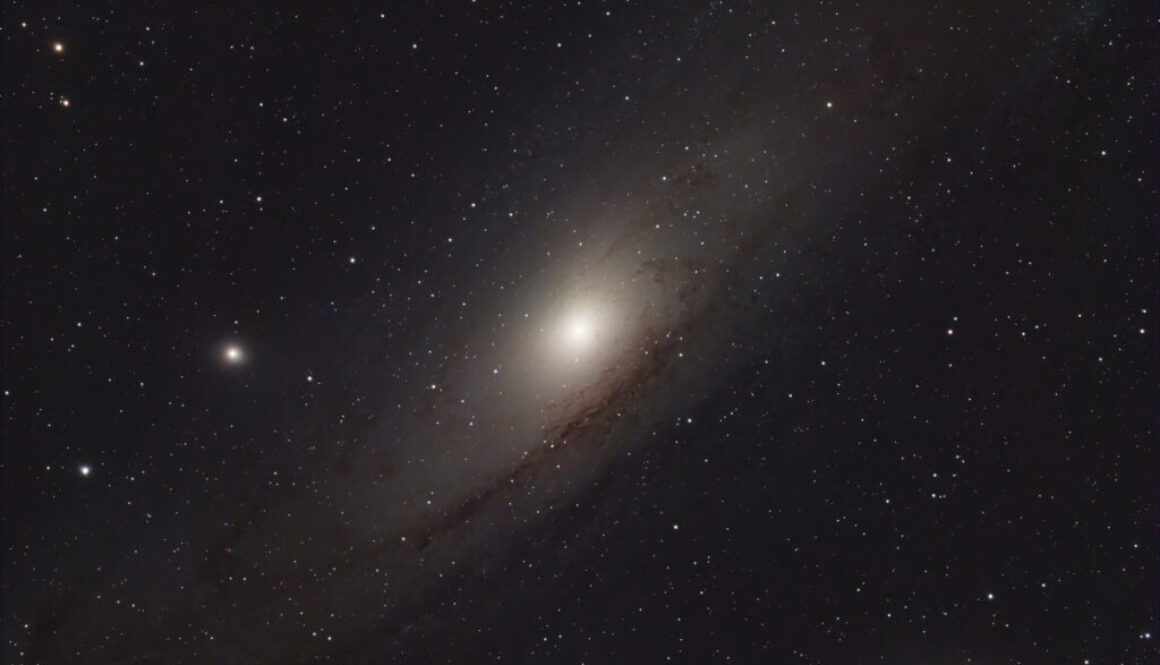
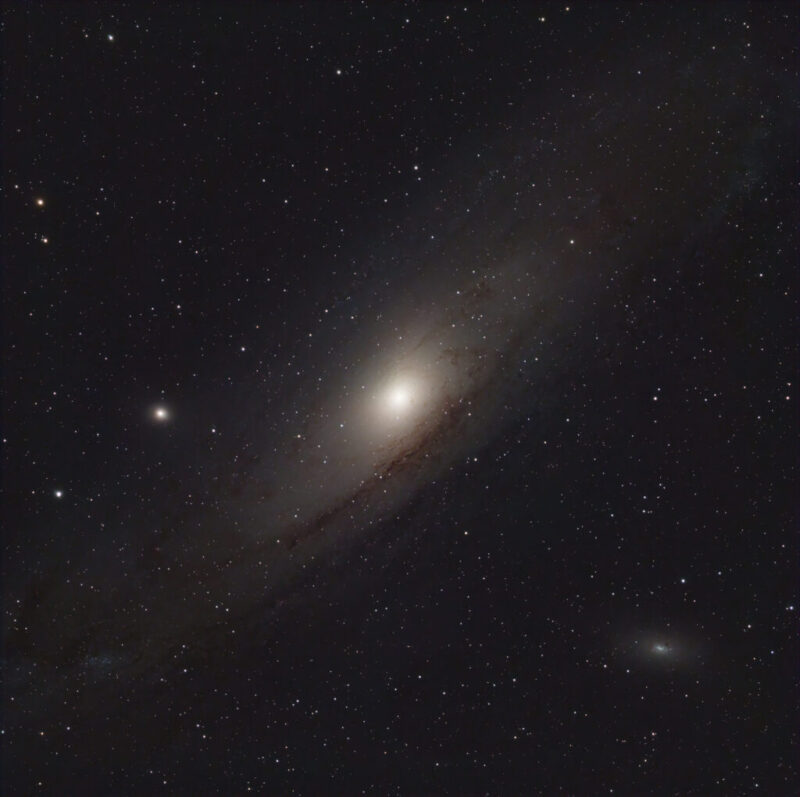
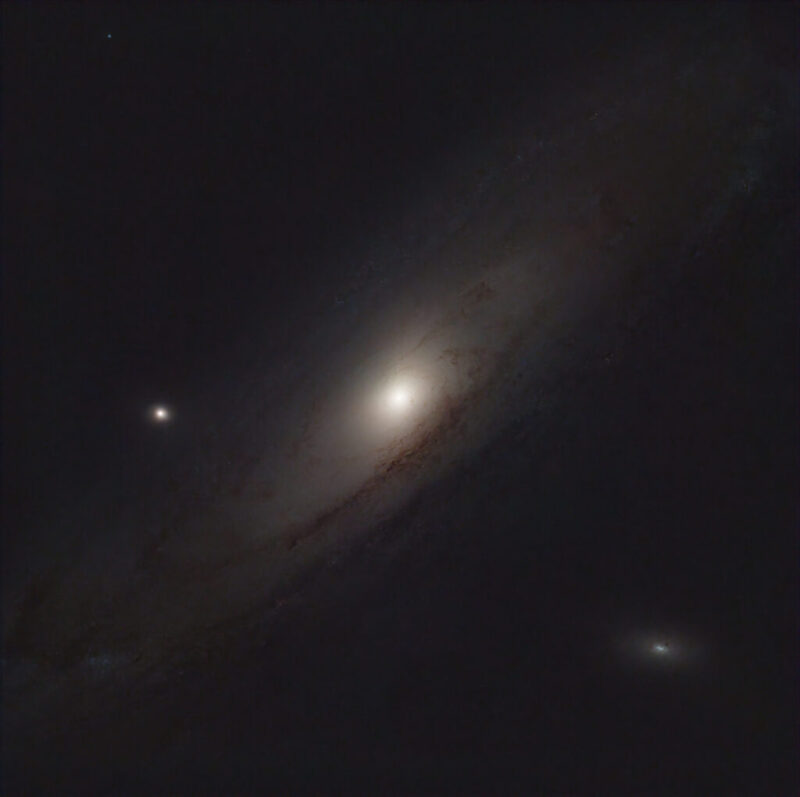
On September 30 I took advantage of a beautiful clear night and I pointed my telescope to the Andromeda Galaxy (M31). This was a first with my ES ED80mm CF APO refractor.
When I analyzed the PHD2 log I knew that something good was happening…
Next, I spent several hours processing the data in PixInsight.
The final processed image of the Andromeda Galaxy was was simply mind-blowing!
You can see some fine details in the structure of M31, the two companion galaxies (M32 and M110), and Andromeda’s dust lanes, clearly visible in the final image despite the light pollution in my location.
Setup