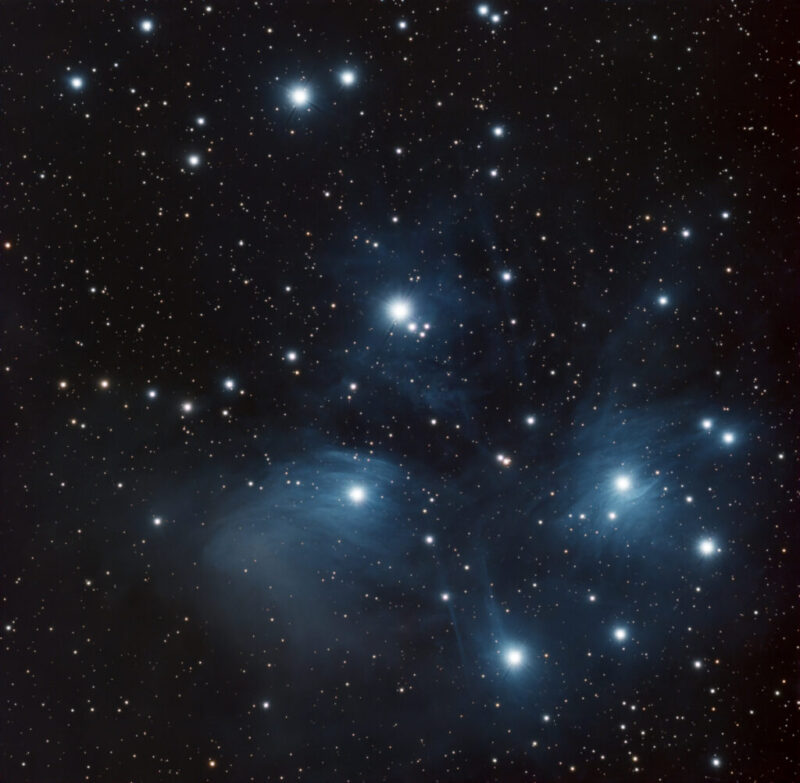
What a night! I spent it imaging the Pleiades (M45) from my backyard in Richmond Hill (Bortle 7-8), as I continue implementing incremental optimizations to my NINA imaging setup. The sky transparency was above average, and at times even excellent, allowing this iconic cluster and its delicate blue reflection nebulae to shine beautifully despite the city glow.
M45 – known in Greek mythology as the Pleiades or the Seven Sisters, and in Japanese as Subaru – is a young open cluster about 440 light-years away in Taurus. It contains hot blue stars that illuminate nearby interstellar dust, creating the famous bluish reflection nebula that surrounds the cluster. The glow is not coming from the stars themselves, but from starlight scattered by fine dust grains drifting through space.
My biggest dilemma for the night was exposure time:
More 120-second subs to avoid oversaturating the brightest stars, or fewer 180-second subs to capture more of the faint blue dust?
I chose 120-second exposures, collecting 3 hours of total integration, and I am overall very happy with how it turned out.
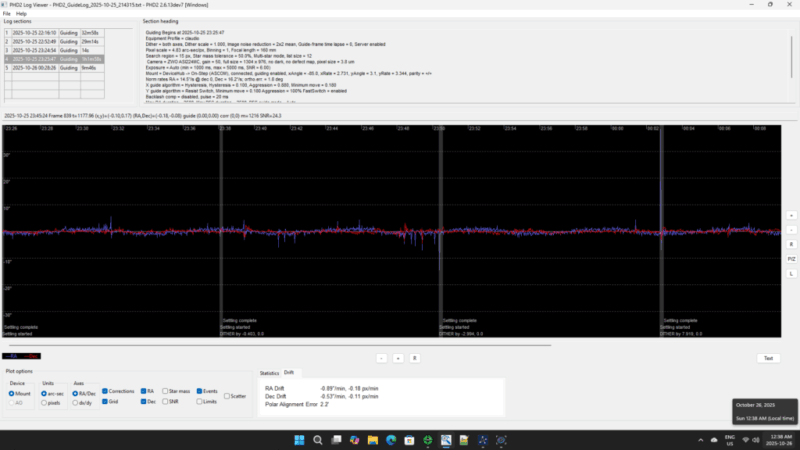
Guiding was a dream – as the PHD2 chart screenshot shows, the guiding lines stayed almost perfectly flat throughout the session.
I also added GroundStation notifications via Pushover to my Advanced Sequence in NINA, so I now get real-time alerts directly on my smartphone for every key step (and for any errors, if they occur): session start and end, mount homing, flat capture, camera warm-up, full equipment disconnect, and even PC shutdown, all handled automatically through the sequence.
I’m really happy with the level of control and reliability I’ve reached. One of my next planned improvements is to create a custom horizon profile in NINA for more precise scheduling and optimized imaging time.
The reflection nebulosity around the Pleiades is clearly visible after just three hours of integration, but I plan to add more hours on the next clear nights to bring out even finer dust details.