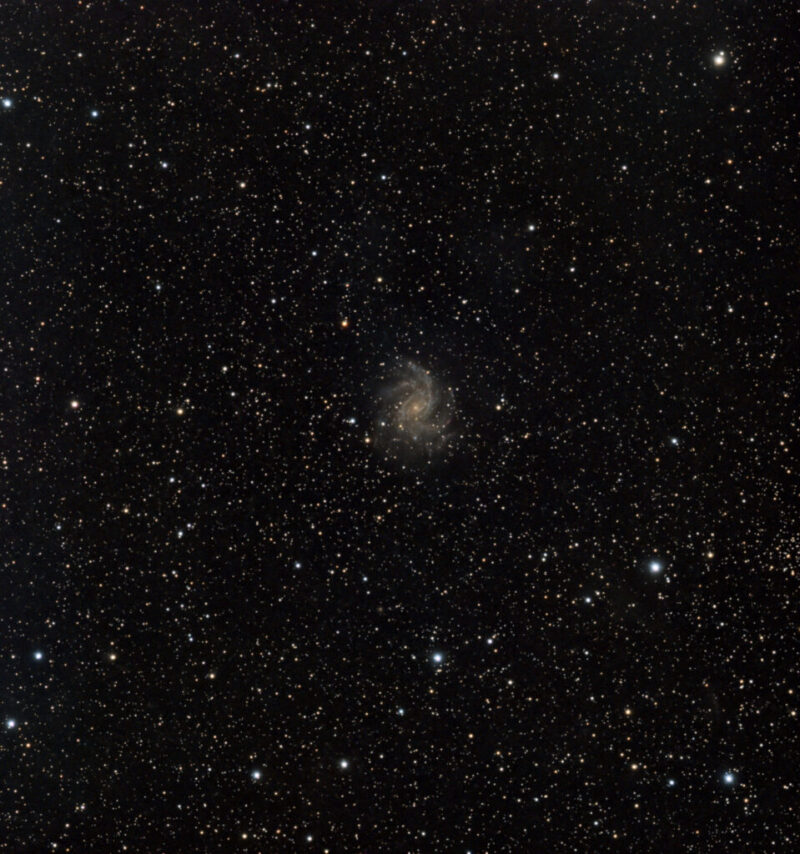
I Imaged the Fireworks Galaxy
NGC 6946 is also known as the Fireworks Galaxy, because it has produced about ten supernovae in the last 100 years! Its last major observed supernova was SN 2017eaw.
Its distance is about 25 million light-years away, and it is located along the border of Cepheus and Cygnus.
NGC 6946 is a galaxy that somehow flies under the radar for many astroimagers, overshadowed by more iconic galaxies. However, the Fireworks Galaxy hides a “cold case”: a star that didn’t go out with a bang, but simply vanished.
Astronomers observed what may be a “failed supernova” in the Fireworks Galaxy. The star, known as N6946-BH1, was a massive red supergiant about 25 times the mass of our Sun. After a modest brightening in 2009, it mysteriously faded from view and had completely disappeared from optical observations by 2015.
Rather than exploding in a typical supernova, scientists believe the star’s core collapsed directly into a black hole. This process likely caused the outer layers to fall inward, effectively swallowing the star from within. Today, only a faint infrared signal remains, possibly the last trace of material falling into the newly formed black hole.
I imaged this galaxy a few days ago (on May 15) from my backyard in Richmond Hill, under less than ideal sky conditions (transparency was very poor and it was windy and humid), but I was able to obtain a total integration time of about 2 hours.
Imaging details
-
Scope: Explore Scientific ED80 CF (80 mm apochromatic refractor)
-
Camera: ZWO ASI533MC Pro (OSC)
-
Filter: Optolong L-Pro light pollution filter
-
Mount: Juwei 17
-
Software: NINA (Nighttime Imaging ‘N’ Astronomy) on a Mele Quieter 4c mini-PC (Windows 11), accessed via Remote Desktop
-
Processing: PixInsight and GIMP