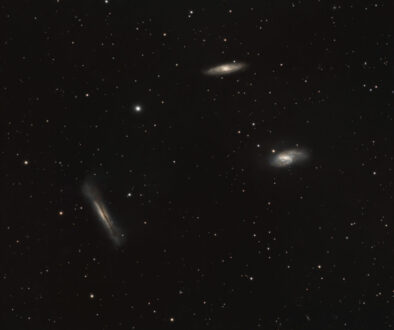
M13 Revisited: A Deeper, More Colorful Look at the Hercules Cluster
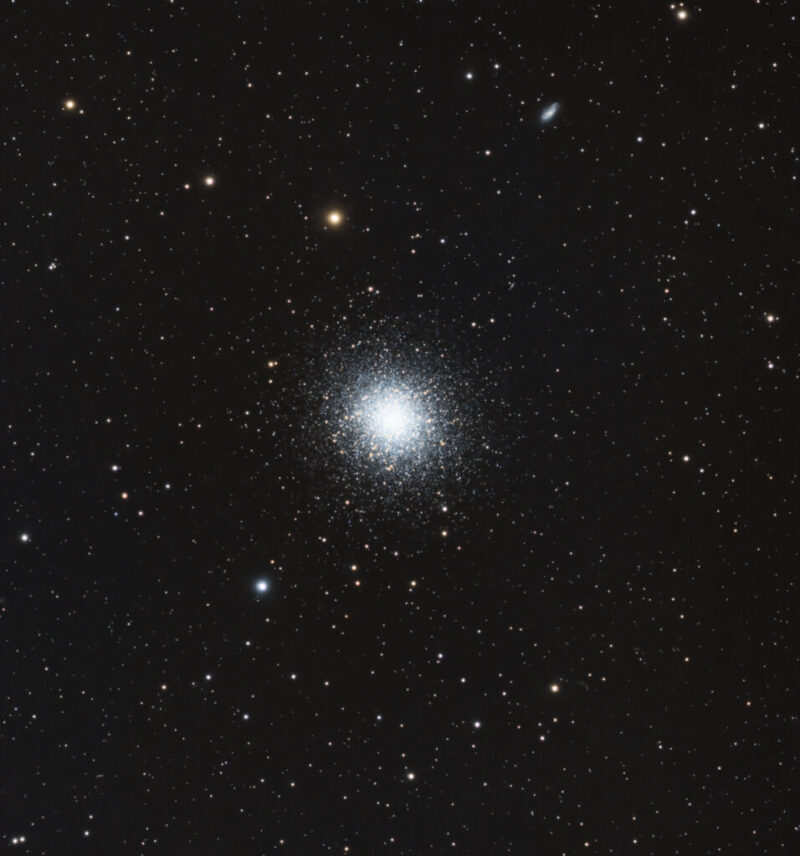
On the night of June 12, 2026 I set up my imaging rig to capture Messier 13 from my backyard in Richmond Hill. Over the course of the night I collected 90 minutes of exposure time, then processed the data with PixInsight.
Globular clusters like M13 are ancient, roughly spherical families of stars that orbit far out in the halo of our Milky Way galaxy. M13 is about 25,000 light‑years away and contains several hundred thousand stars packed into a region only a few hundred light‑years across. If you could stand on a planet orbiting one of the stars near the cluster’s core, your night sky would be filled with so many bright stars that it would never get truly dark: it would be “always daytime” there!
M13 also has a special place in the story of our search for extraterrestrial intelligence. In 1974, astronomers used the giant Arecibo radio telescope in Puerto Rico to send a radio message toward this cluster. The message encoded simple pictures and facts about humanity, our DNA, and the Solar System, mainly as a demonstration of what the radio telescope could do. Even if anyone is listening, the message will take about 25,000 years to reach M13, and a reply would take another 25,000 years to come back… so this is a very long‑distance conversation!
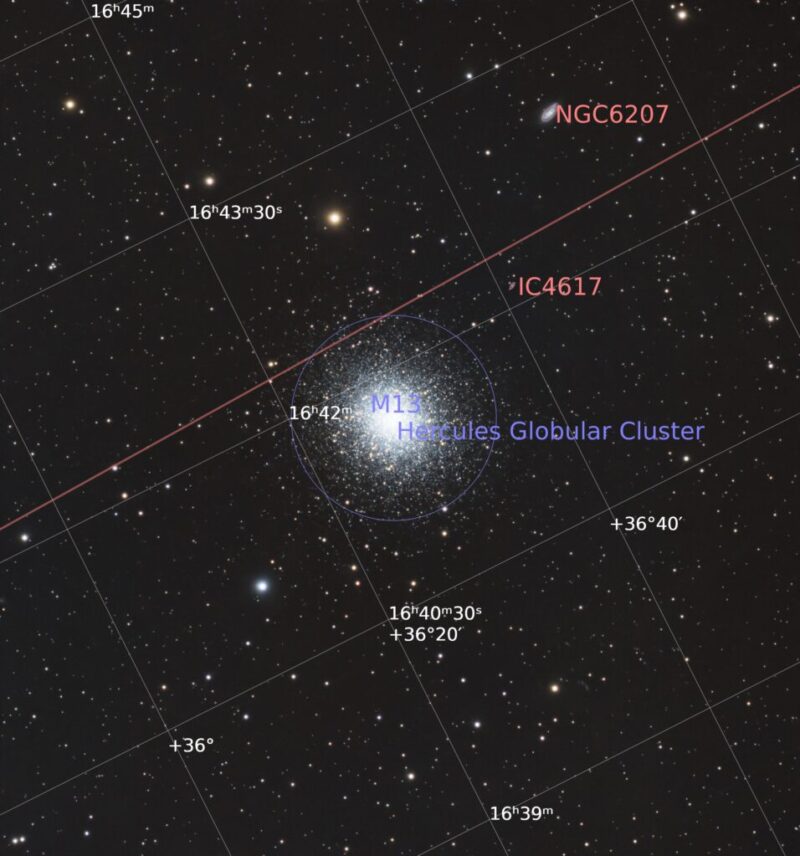
But in the image there is more… If you look carefully, this image shows much more than just the globular cluster. Above and to the right of the cluster sits the small, edge‑on spiral galaxy NGC 6207, approximately 45 million light‑years away (hundreds of times farther than M13). Even smaller and fainter is IC 4617, a tiny streak between M13 and NGC 6207, and its distance is mind‑blowing: about 553 million light‑years away!
In a single frame, you can see stars in our own galaxy, a cluster in our galactic halo, and galaxies far beyond.
For those interested in the technical side, here is the gear used for this image:
- Telescope: Explore Scientific ED80 CF APO refractor
- Mount: Juwei 17 strainwave mount
- Main camera: ZWO ASI533MC‑PRO, cooled to -10 °C
- Filter: Optolong L‑Pro light‑pollution filter
- Guiding: Orion Mini 50 mm guidescope with ZWO ASI224MC, guided with PHD2
- Exposure: 45 images × 120 seconds each (total integration 90 minutes)
- Control: NINA running on a Mele Quieter 4C mini‑PC at the telescope, accessed remotely from a smartphone via the Touch’N’Stars NINA plugin
- Processing: PixInsight, GIMP