Hello Darkness, My Old Friends: Imaging two Beautiful Galaxies in Ursa Major
It had been almost five months since my last deep-sky imaging session. Life commitments and work deadlines got in the way, and let’s be honest, the weather in the GTA from November 2025 through March 2026 was brutally uncooperative. Endless clouds, so much snow and rain, and that bone-chilling dampness that made me question why I live here…
My telescope was stored somewhere in my basement, patiently waiting for better times. But yesterday (April 11, 2026) the weather finally cooperated. Clear skies over Richmond Hill, and the temperature not too cold (just +3 degrees). I set up everything out in my backyard well in advance, feeling that familiar mix of excitement and nerves, and carefully planned my imaging targets for the night to get the best from the short imaging time before the clouds were forecasted to roll in.
Windows updates, of course, tried to derail me, popping up just as I powered on the Mini PC. “Not tonight,” I declared, postponing the update while the mount switched back to life.
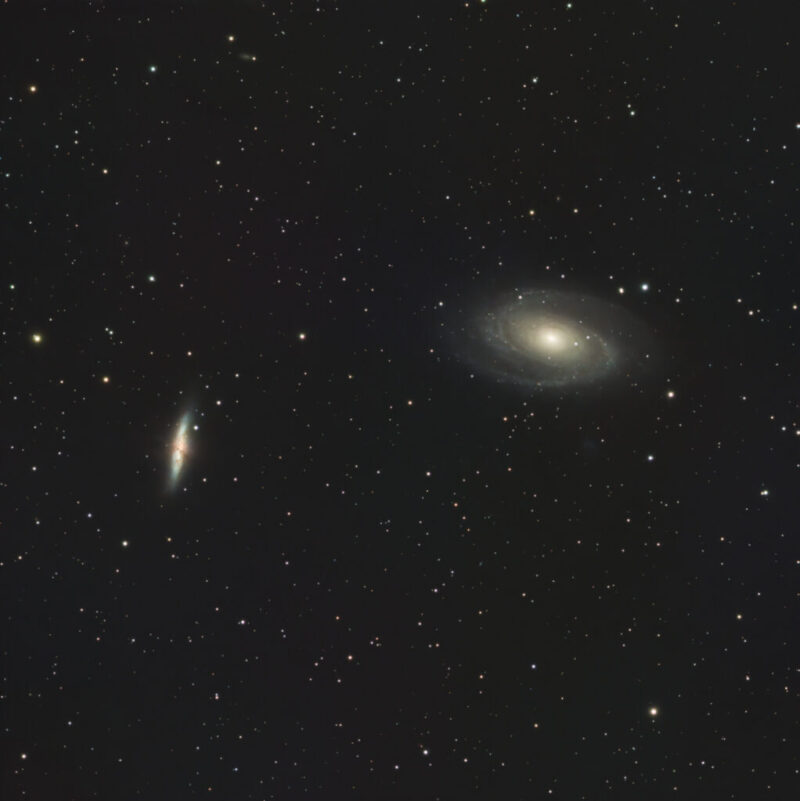
Polar alignment wasn’t the best; it was a bit off, but good enough to start. I didn’t want to waste even 1 minute of my imaging time. I targeted two old favorites that are high in the sky for a number of hours at this time of the year: M81 (Bode’s Galaxy) with its elegant spiral arms, and M82 (the Cigar Galaxy). 50 frames at 120 seconds each, simple stacking and dithering under a sky that felt like a gift after the long drought.
I sat inside monitoring that everything was running smoothly through the night, and I patiently waited for the photons to be collected. I was feeling so good today while post-processing the images through PixInsight. I tried MultiscaleAdaptiveStretch (MAS) to reveal hidden structures inside this galaxy duo: STF for the initial stretch, DBE to remove gradients, SPCC for color calibration, BXT and NXT for sharpening and noise reduction, Curves Transformation, and a final touch with GIMP.
Considering that the total integration time is a little bit less than 2 hours, I’m quite satisfied with the final result. M81’s glow and spirals, M82’s textured chaos.
Astrophotography isn’t always perfect setups or flawless data. Most of the time, it’s troubleshooting a piece of equipment that suddenly behaves in a weird way, waiting for months for the weather to cooperate, fighting Windows updates, overcoming imperfect alignment, and rediscovering the joy in the wait. Looking forward to many more nights like this during galaxy season!